
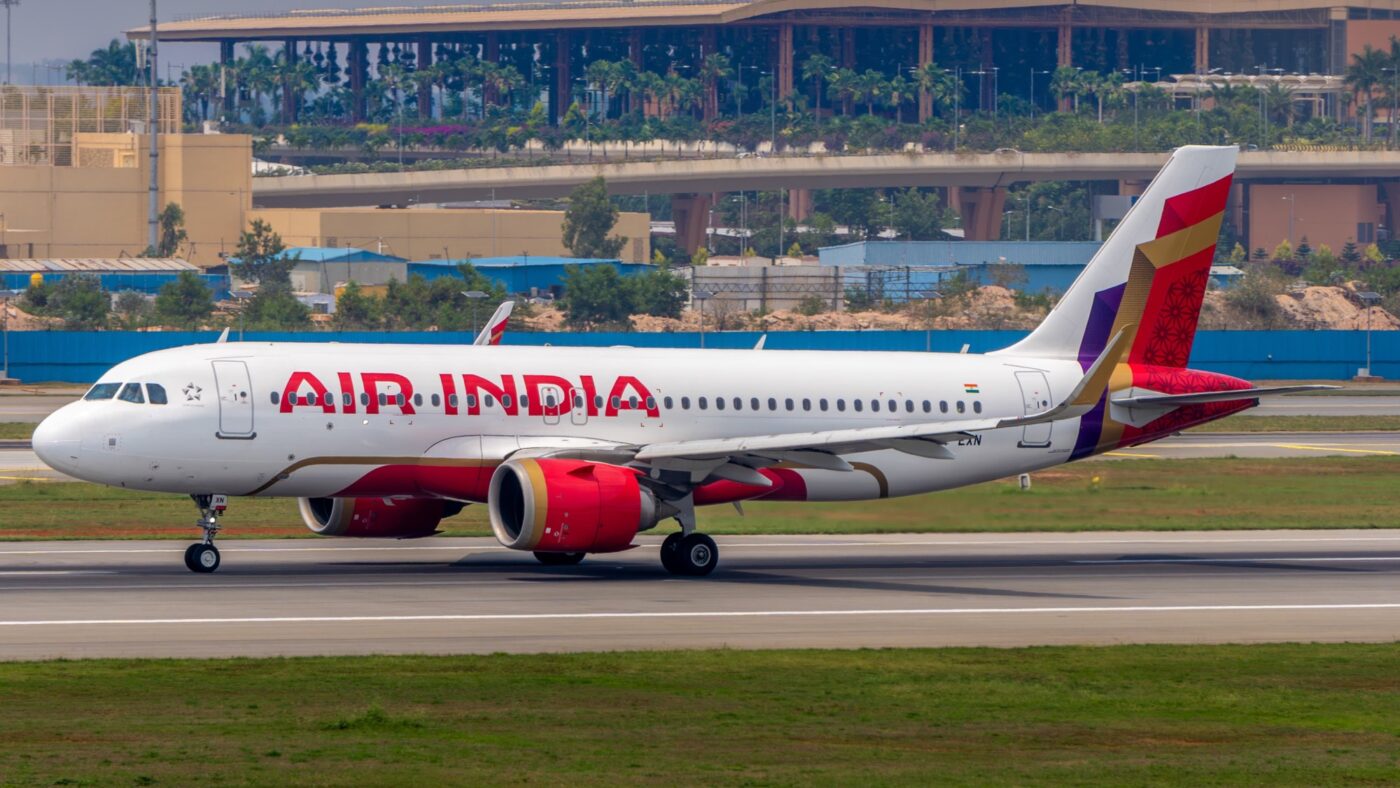
NEW DELHI — India’s Aircraft Accident Investigation Bureau (AAIB) has released its preliminary report into the 4 August 2026 accident involving an Air India Airbus A320-251N, registered VT-EXO.
The aircraft was operating flight AI2379 from Phuket, Thailand, to New Delhi when it experienced a highly unusual, near-simultaneous loss of pressure in all three hydraulic systems while cruising at Flight Level 360.
The event triggered an autopilot disconnection, a brief stall warning and a significant vertical deviation. The aircraft subsequently recovered and landed safely in Delhi. The preliminary report provides a detailed reconstruction of the event but does not yet establish a final cause.
A rare multi-system hydraulic event
The sequence began at approximately 04:02:43 UTC, when the aircraft recorded a loss of pressure in the green hydraulic system. Within approximately four seconds, the blue and yellow systems were also affected.
The A320 is equipped with three independent hydraulic systems: green, yellow and blue, designed to provide redundancy for the aircraft’s primary flight controls and numerous other systems. Hydraulic pressure supplies the force required by the aircraft’s flight-control actuators, while pilot inputs are transmitted electrically through the A320’s fly-by-wire flight-control system.
The architecture is specifically designed so that the loss of a single hydraulic system does not result in a loss of aircraft control. A near-simultaneous loss of pressure indications across all three systems is therefore highly unusual and represents a substantially different scenario from a conventional single-system failure.
At present, however, the AAIB has not determined whether all three systems actually experienced an independent physical loss of hydraulic pressure, whether a common technical failure affected multiple systems, or whether an issue with the relevant indications played a role.
The rapid recovery of the systems is an important part of the investigation. The blue system recovered first, followed by the yellow and green systems, restoring the associated flight-control functionality within seconds.
Autopilot disconnect and altitude upset
The hydraulic warnings were followed almost immediately by changes in the aircraft’s flight-control configuration. The autopilot disconnected shortly after the initial hydraulic indications, and a stall warning was subsequently recorded for approximately two seconds.
The aircraft then experienced a pronounced vertical upset. According to the preliminary investigation data, AI2379 initially climbed approximately 372 feet above its assigned flight level before descending approximately 292 feet below it.
The event was therefore not simply a conventional altitude loss, but a rapid vertical excursion involving both an initial climb and subsequent descent.
The aircraft ultimately stabilised as hydraulic pressure returned and continued towards New Delhi. The sudden movement nevertheless had significant consequences inside the cabin.
With the seatbelt signs reportedly not illuminated at the time, 20 passengers and four cabin crew members out of 145 people on board were injured.
The A320 hydraulic architecture
Understanding the significance of the event requires a closer look at the A320’s hydraulic system.
The aircraft’s three hydraulic systems are normally operated independently, although the architecture incorporates several means of transferring or supplementing hydraulic power when required. The green and yellow systems provide hydraulic power to a large number of aircraft functions, while the blue system provides an additional independent source.
The Power Transfer Unit (PTU) is an important part of this architecture. It can transfer hydraulic power between the green and yellow systems without transferring hydraulic fluid itself. This allows one system to assist the other when there is an appropriate pressure differential.
This redundancy is a key element of the A320’s system design. Even after the loss of one hydraulic system, sufficient control and system capability remains available through the others.
The AI2379 event is therefore technically significant because the recorded sequence involved all three hydraulic systems within only a few seconds. At the same time, the fact that hydraulic pressure returned rapidly makes the event different from a straightforward multiple-system leak or permanent pump failure.
Investigators will therefore need to determine what initiated the pressure losses and whether a common-mode mechanism could have affected systems that are normally independent.
PTU deferred under the MEL
The aircraft’s maintenance history has provided another important point for investigators.
The PTU had been deferred under the Minimum Equipment List (MEL) on 28 July 2026, before the accident flight.
The presence of an MEL deferral does not automatically indicate that the aircraft was operating in an unsafe condition. MEL procedures allow certain items to remain inoperative for a defined period and under specified operational conditions.
Nevertheless, the PTU is directly relevant to hydraulic architecture and is therefore part of the technical investigation.
It is important to stress that the AAIB preliminary report does not establish a causal link between the deferred PTU and the loss of hydraulic pressure. Whether the PTU had any influence on the event remains to be determined through further examination of the aircraft and its system data.
Crew toxicology finding
The preliminary investigation also identified a separate issue involving the flight crew.
Following the flight, both pilots underwent prescribed screening for psychoactive substances. The Pilot-in-Command returned a non-negative result requiring confirmatory analysis, while the First Officer’s test did not produce the same finding.
A subsequent finding involving a psychoactive substance resulted in Air India terminating the captain’s employment. The finding has attracted considerable attention, but it must be separated from the technical investigation.
A significant test of system redundancy
AI2379 is particularly notable because it demonstrates both the strength and the limits of modern aircraft redundancy.
The A320’s hydraulic architecture is designed to prevent a single failure from developing into a loss of control. In this case, the aircraft encountered an extremely unusual multi-system event, yet hydraulic pressure returned within seconds and the aircraft remained capable of completing its flight safely.
At the same time, the event demonstrates why redundancy alone does not eliminate the importance of common-mode failures. If several nominally independent systems are affected by a single initiating mechanism, the protection provided by redundancy can be temporarily reduced.
Cause remains open
Investigators will continue to examine the aircraft’s hydraulic components, associated indications and sensors, flight-recorder data and maintenance history, including the PTU MEL deferral, to determine the initiating cause.
Airbus is supporting the investigation, with France’s Bureau d’Enquêtes et d’Analyses (BEA) also involved.
The significance of AI2379 lies in the unusual combination of a near-simultaneous multi-system hydraulic event, temporary disruption of flight-control functionality, a measurable altitude upset and the rapid recovery of the hydraulic systems.
The final investigation is expected to determine whether this sequence resulted from a common technical mechanism, an indication anomaly or another factor, and whether any lessons should be incorporated into the operation or maintenance of the Airbus A320 fleet.