Media Report: Carl Antrak & Muneeb Windvogel | Aviation24news
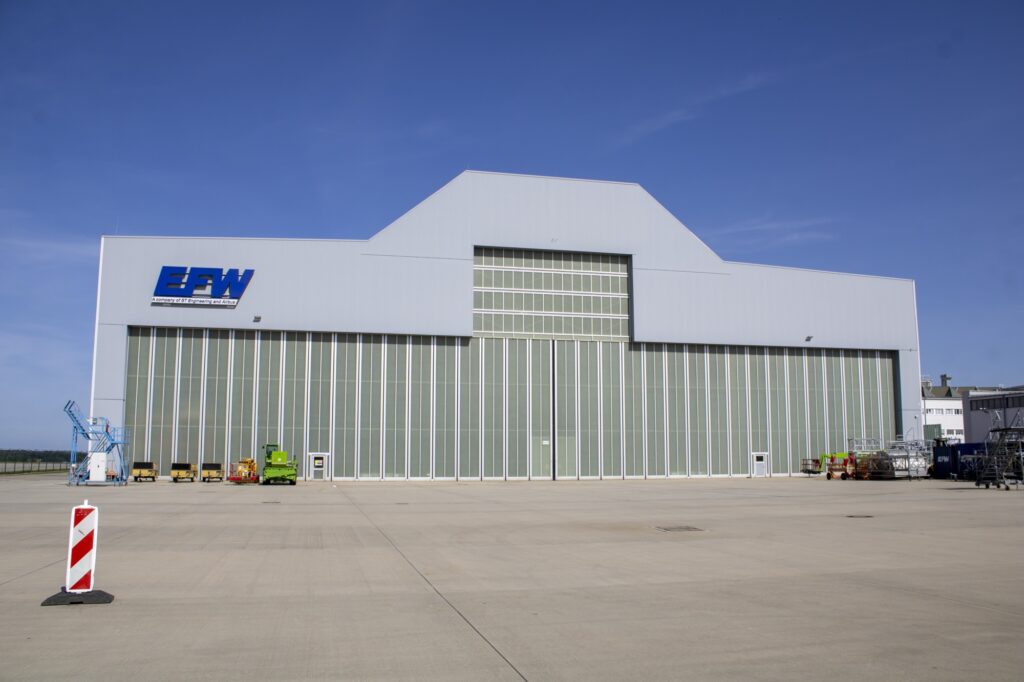
DRESDEN, Germany — Aviation24news attended the official media presentation at Elbe Flugzeugwerke (EFW) in Dresden, where Discover Airlines began the world’s first AeroSHARK installation on an Airbus A330. The project marks another milestone for the biomimetic technology, which has already been introduced on Boeing 777s and Boeing 747s across several international airlines.
Aviation24news was invited to see the installation process firsthand, speak with members of the project team and learn more about the engineering, logistics and economics behind AeroSHARK.
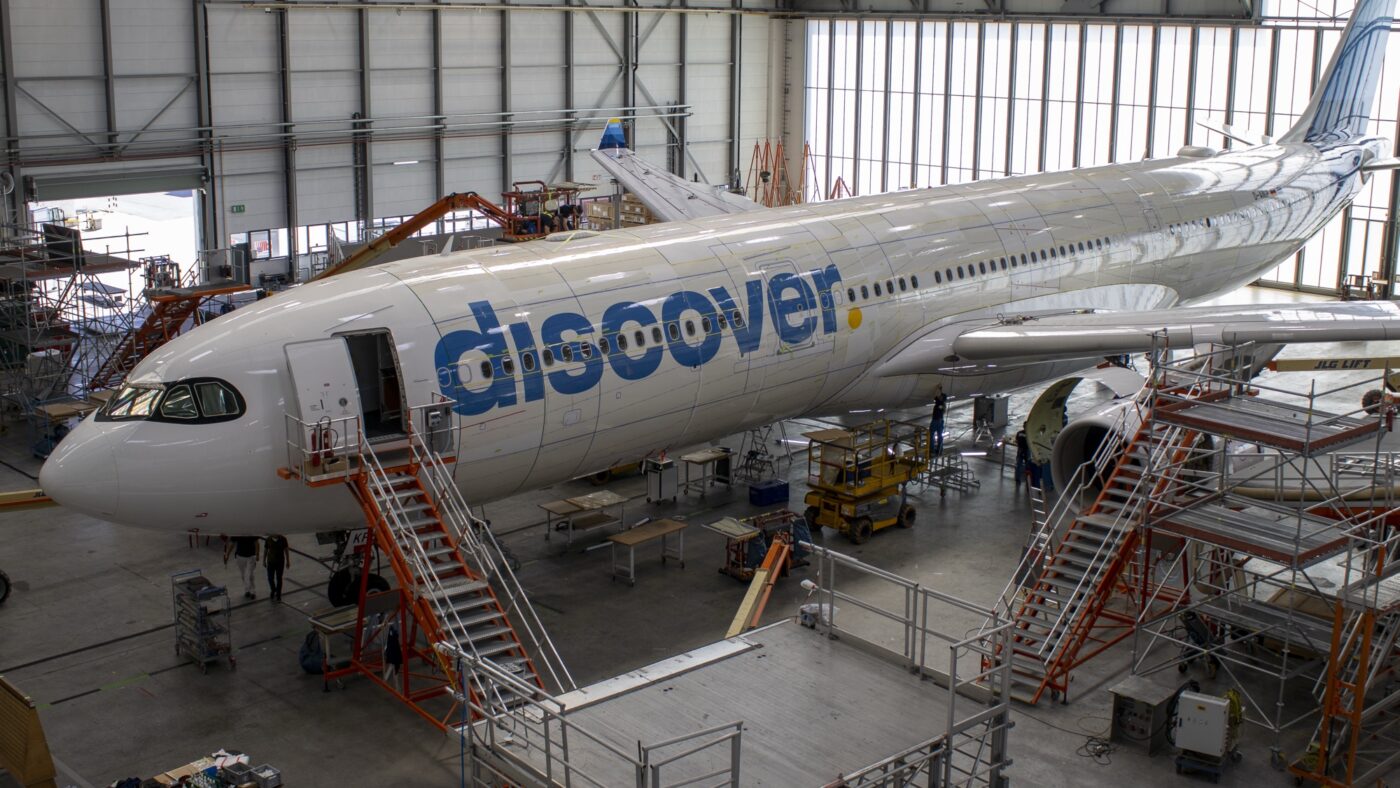
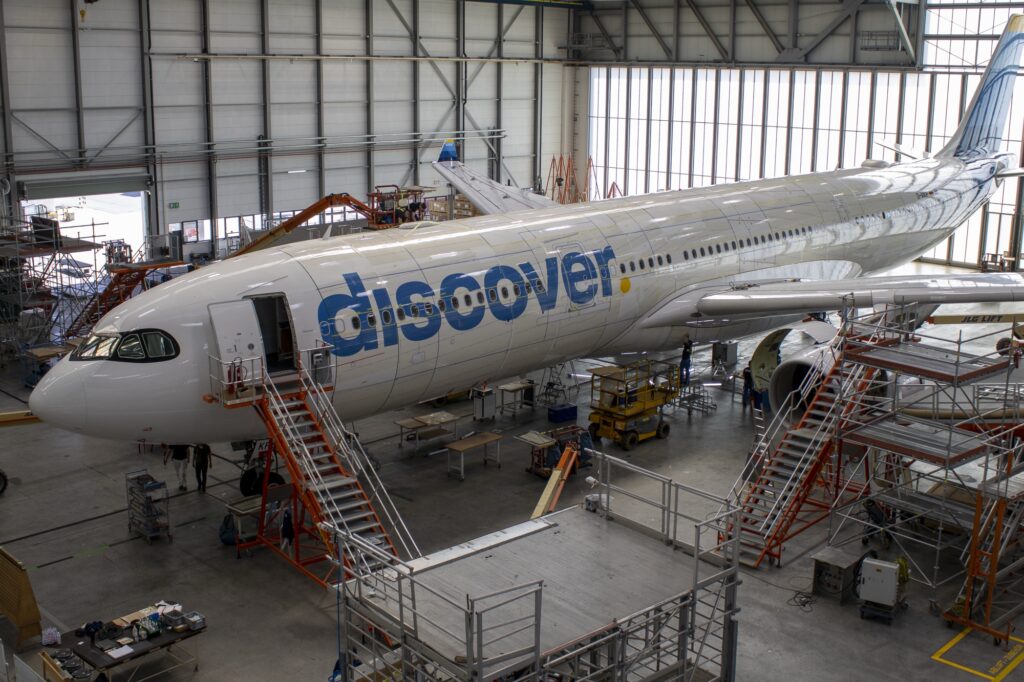
The aircraft selected for the project is an Airbus A330-343 registered D-AIKP, MSN 1292, which is currently being fitted with approximately 885 square meters of AeroSHARK film. The technology is designed to reduce aerodynamic drag across the aircraft’s exterior, with the resulting reduction in drag potentially lowering fuel consumption and emissions during flight.
Three Years in the Making
According to Jule Klein, discussions surrounding the introduction of AeroSHARK at Discover Airlines began around three years ago. The project brings together Discover Airlines, Lufthansa Technik and EFW, with each organization playing a specific role. Discover Airlines provides the aircraft and will evaluate the technology in operational service, Lufthansa Technik is responsible for development, engineering, certification and aerodynamic analysis, while EFW is carrying out the physical installation in Dresden.
The project is therefore not simply a modification to a single aircraft, but part of a wider program to evaluate how AeroSHARK can be introduced across additional aircraft types and potentially expanded to larger areas of aircraft in the future.
Mimicking Shark Skin to Reduce Drag
AeroSHARK is a specially engineered adhesive film featuring a microscopic surface structure known as riblets. The structures are approximately 50 micrometers thick and mimic the texture of shark skin. Their purpose is to optimize airflow over the aircraft’s exterior and reduce aerodynamic drag as the aircraft moves through the air.
According to Johannes Helldorf, Head of AeroSHARK at Lufthansa Technik, AeroSHARK does not change the aircraft’s flying characteristics. Instead, the technology specifically influences airflow and drag, with the resulting effects measured and analyzed throughout the project. That distinction is important because the modification is not intended to alter how the A330 handles or flies, but rather to make the aircraft aerodynamically more efficient. The resulting data will ultimately be submitted to the relevant aviation authorities as part of the certification and approval process.
A Technology already Flying Commercially
Although D-AIKP is the first Airbus A330 to receive AeroSHARK, the technology is already being used commercially. A total of 31 aircraft are currently flying with AeroSHARK, including Boeing 747-400s and Boeing 777-300ERs, with seven airlines currently operating aircraft equipped with the technology. Among them are LATAM, Lufthansa, SWISS and ANA.
The Airbus A330 therefore represents the next major aircraft type for the technology, with the Discover Airlines installation providing an opportunity to gather further operational data and determine how the system performs on another widely used long-haul aircraft.
First AeroSHARK installation at Discover Airlines
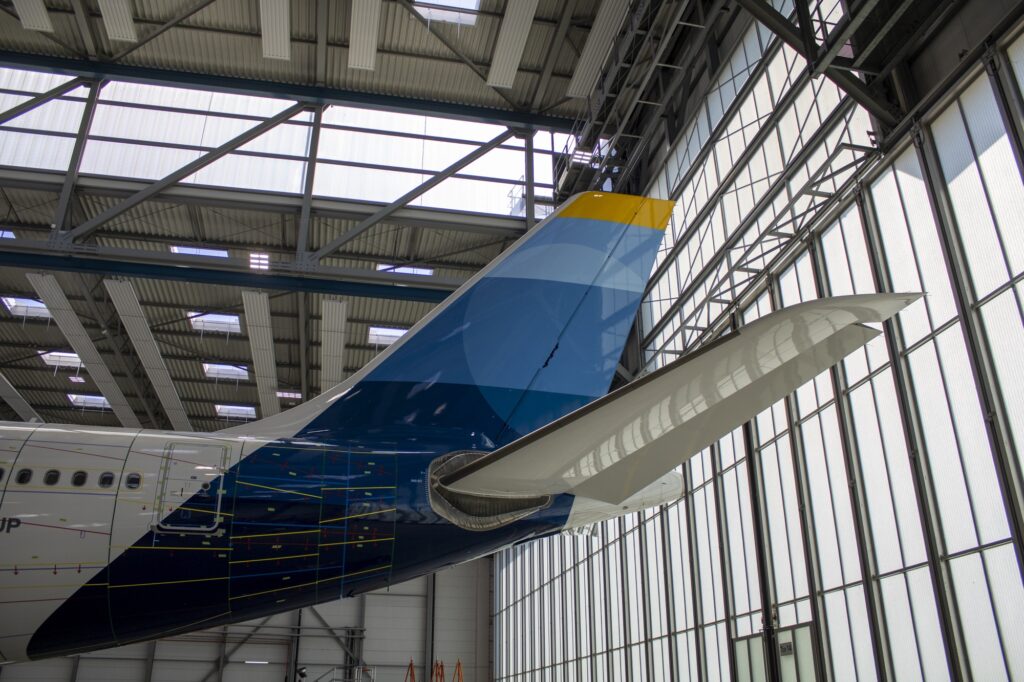
For Discover Airlines, the current project involves the Airbus A330-343 D-AIKP. Approximately 885 square meters of AeroSHARK film will be applied to the aircraft, primarily across the fuselage and engine nacelles. The wings and empennage are not included at this stage because these surfaces have a substantially greater influence on the aircraft’s aerodynamics, meaning that applying the technology to them requires additional research, development and validation.
The current approach is therefore to demonstrate and measure the effects of AeroSHARK on the fuselage and engines first. Future applications to the wings and tail are already being studied, however, and larger surfaces could potentially receive the riblet film as the technology develops. AeroSHARK is also being considered for future aircraft such as the Boeing 777X, Airbus A330neo and Airbus A350. There is even a longer-term possibility of the technology being applied during aircraft production rather than being retrofitted later in an aircraft’s life, although such applications remain some way off.

Installation Requires Extensive Manual Work
Despite the highly specialized engineering behind AeroSHARK, the installation itself relies heavily on manual work. The process begins with careful preparation of the aircraft’s exterior, with special cleaning agents used to ensure that the surface is properly prepared before the film is applied.
Technicians then place positioning tape across the aircraft to establish the precise location of each individual section. Once the positioning has been verified, the AeroSHARK film is applied to the prepared surface and its protective layer is removed. A detailed final inspection then takes place to ensure that the film has been correctly installed, with specialized hand tools used to remove air bubbles and wrinkles and ensure that it sits correctly against the aircraft’s surface.
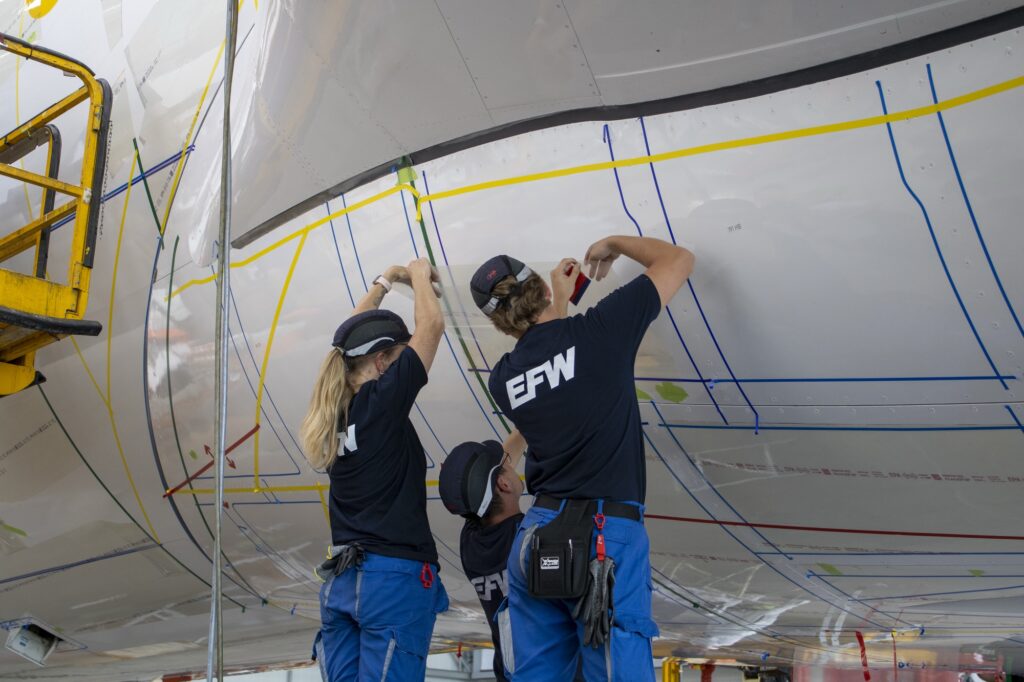
Despite the advanced nature of the technology, only a relatively small number of specialized hand tools are required during the installation itself. The process combines sophisticated aerodynamic engineering with highly precise manual workmanship across hundreds of square meters of an aircraft.
Five to Seven days for a Standard Installation
For aircraft such as the Boeing 777 and Airbus A330, an AeroSHARK installation generally takes around five to seven days. The first installation on a particular aircraft type can take considerably longer, however, with an initial installation potentially requiring approximately 10 to 14 days because of the additional engineering, validation and inspection work involved.
For D-AIKP, the process therefore represents not only the physical application of the film but also an important engineering and validation exercise. As the first Airbus A330 to receive AeroSHARK, the aircraft will provide valuable information for future A330 installations and the development of the system.
Testing the aircraft before and after installation
The installation is only one part of the project. Following the modification, the aircraft undergoes further test flights so engineers can determine how the technology performs under real-world operating conditions. Two test days have already taken place, with each involving approximately six hours of flying, while another test is scheduled for the following week.
Engineers compare complete flight data from before and after the AeroSHARK modification, allowing them to assess the actual aerodynamic effects of the film rather than relying solely on theoretical calculations. The data collected will form an important part of the certification process, with the results eventually submitted to the relevant authorities. Approval is expected later this year.
The Fuel and Emissions Benefits
The main benefit of AeroSHARK is lower fuel consumption through reduced aerodynamic drag. The program expects equipped aircraft to achieve around 1% lower jet fuel consumption per year, equivalent to approximately 300 to 400 tonnes of fuel saved annually, depending on the aircraft and its operation.
For a Boeing 777-300ER, this corresponds to approximately 360 tonnes of fuel saved, 1,125 tonnes less CO₂ and around €360,000 in annual savings. The greatest benefits are expected on long-haul flights, where aircraft spend extended periods at cruise altitude and aerodynamic efficiency becomes particularly important.
The technology therefore has both an environmental and economic dimension. Reducing drag means the aircraft requires less energy to maintain its flight, potentially lowering fuel costs for the airline while also reducing the emissions associated with that fuel burn. According to Sönke Burger, airlines are expected to achieve a return on investment within approximately two years, making the technology particularly relevant from a commercial perspective as well as an environmental one.
From Shark Skin to Commercial Aviation
The concept behind AeroSHARK is based on a relatively simple observation from nature: shark skin has a highly structured surface that helps manage the flow of water around the animal. Engineers have adapted that principle for aviation by creating microscopic riblets on a film that can be applied to aircraft surfaces.
The challenge is turning that microscopic structure into a product that can be installed across hundreds of square meters of an aircraft, withstand the demanding conditions of commercial aviation and deliver a measurable benefit. The Discover Airlines A330 program represents the latest step in that development, taking a technology already proven on Boeing aircraft and applying it to an Airbus A330 for the first time.
For Discover Airlines, the project has taken around three years to reach this stage. The installation in Dresden is now providing engineers with another opportunity to measure the real-world effects of the technology, while the operational data gathered from D-AIKP could help determine how widely AeroSHARK can eventually be deployed.
Jule Klein, Director of Engineering at Discover Airlines, summed up the long-term approach to the project with a message focused on patience and execution:
“People don’t board an aircraft because they want to sit next to someone who snores or eat mediocre food. They board because they have a destination. It’s the same for us. This project takes time, and it isn’t always easy, but we want to do it well—for you, for us, and for everyone.”
With D-AIKP becoming the first Airbus A330 to receive AeroSHARK, the Dresden installation marks another significant step for a technology that has moved from biomimicry research into commercial aviation. The results from the aircraft will help establish the technology’s performance on the A330 and could influence its future application across new aircraft types and larger surfaces.
The study of shark skin has developed into a technology being applied across hundreds of square meters of commercial aircraft, with the potential to reduce fuel consumption, emissions and operating costs.
The first A330 installation now provides the industry with another opportunity to see how far that potential can go.