
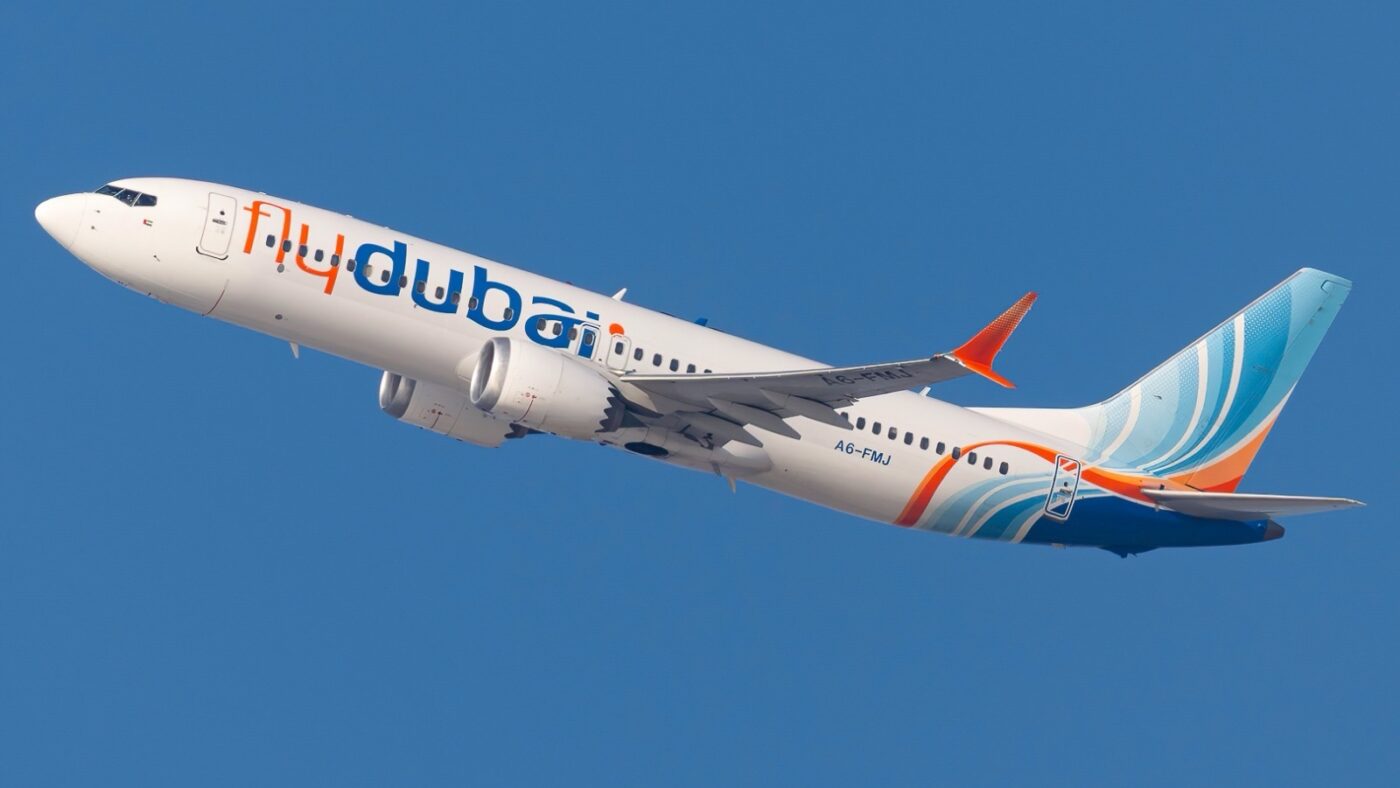
A flyDubai flight from Dubai to Tel Aviv was diverted to Saudi Arabia on Wednesday after an incident involving the aircraft’s pilots triggered emergency signals and an Israeli military response.
Flight FZ1073, operated by a Boeing 737 MAX 8 registered A6-FKF, was travelling from Dubai International Airport to Ben Gurion Airport when the incident unfolded. The aircraft subsequently diverted to Saudi Arabia, landing safely at Tabuk. flyDubai confirmed that all passengers were safe and accounted for.
The aircraft’s flight path showed a dramatic change shortly before the diversion. According to Flightradar24 tracking data, FZ1073 was at around FL340, or 34,000 feet, at approximately 05:21 UTC. By around 05:24 UTC, it had descended to roughly 15,000 feet, representing a loss of around 19,000 feet in approximately three minutes. The tracking data also shows the aircraft subsequently continuing towards Saudi Arabia.
Further reports have since emerged about the confrontation. Israeli officials told Reuters that the co-pilot, who is believed to be an Omani national, allegedly stabbed the captain during the incident. The officials said they are investigating the incident as a possible attempted terrorist attack.
Reports also indicate that the co-pilot may have attempted to interfere with the aircraft’s flight path before the confrontation was brought under control. Passengers and other crew members reportedly intervened, with both pilots subsequently taken to hospital after the aircraft landed in Tabuk. The exact sequence of events remains under investigation.
The rapid descent was accompanied by significant changes to the aircraft’s flight path. Publicly available flight-tracking data showed the aircraft transmitting the general emergency code 7700, before later transmitting 7500, the transponder code associated with unlawful interference. The latter raised concerns that the aircraft could have been hijacked.
The situation was initially understood to have involved a physical altercation between the two pilots rather than a hijacking. However, further reports have since provided additional details about the confrontation, with Israeli officials now investigating whether the incident may have been a deliberate attempt to interfere with the flight. The exact circumstances remain under investigation.
The aircraft’s apparent rudder damage adds another dimension to the severity of the incident. The rudder is a critical flight-control surface that governs the aircraft’s yaw and helps maintain directional control. The reported loss of nearly 14,000 feet in less than 120 seconds would have subjected the aircraft to extreme aerodynamic forces, with images after landing appearing to show damage to the rudder.
It remains unclear who ultimately took control of the aircraft following the confrontation. Reuters reported that cabin crew entered the cockpit and took control, while other reports have suggested that off-duty pilots travelling as passengers may have assisted with the landing. The exact also circumstances remain unclear.
Israeli authorities responded by scrambling fighter aircraft, while Prime Minister Benjamin Netanyahu and Defence Minister Israel Katz held security consultations as the situation developed.
flyDubai said the aircraft had experienced an “incident” while en route to Tel Aviv and was diverted to Tabuk, where it landed safely. The airline said it was working with the relevant authorities as investigations continued.
The diversion was also unusual from a regional perspective. Saudi Arabia does not maintain formal diplomatic relations with Israel, meaning the unexpected arrival of an Israel-bound commercial aircraft carrying Israeli passengers added another layer to an already extraordinary flight. Israeli authorities said efforts were being made to return the passengers to Israel.
This is a developing story. More updates to follow.