
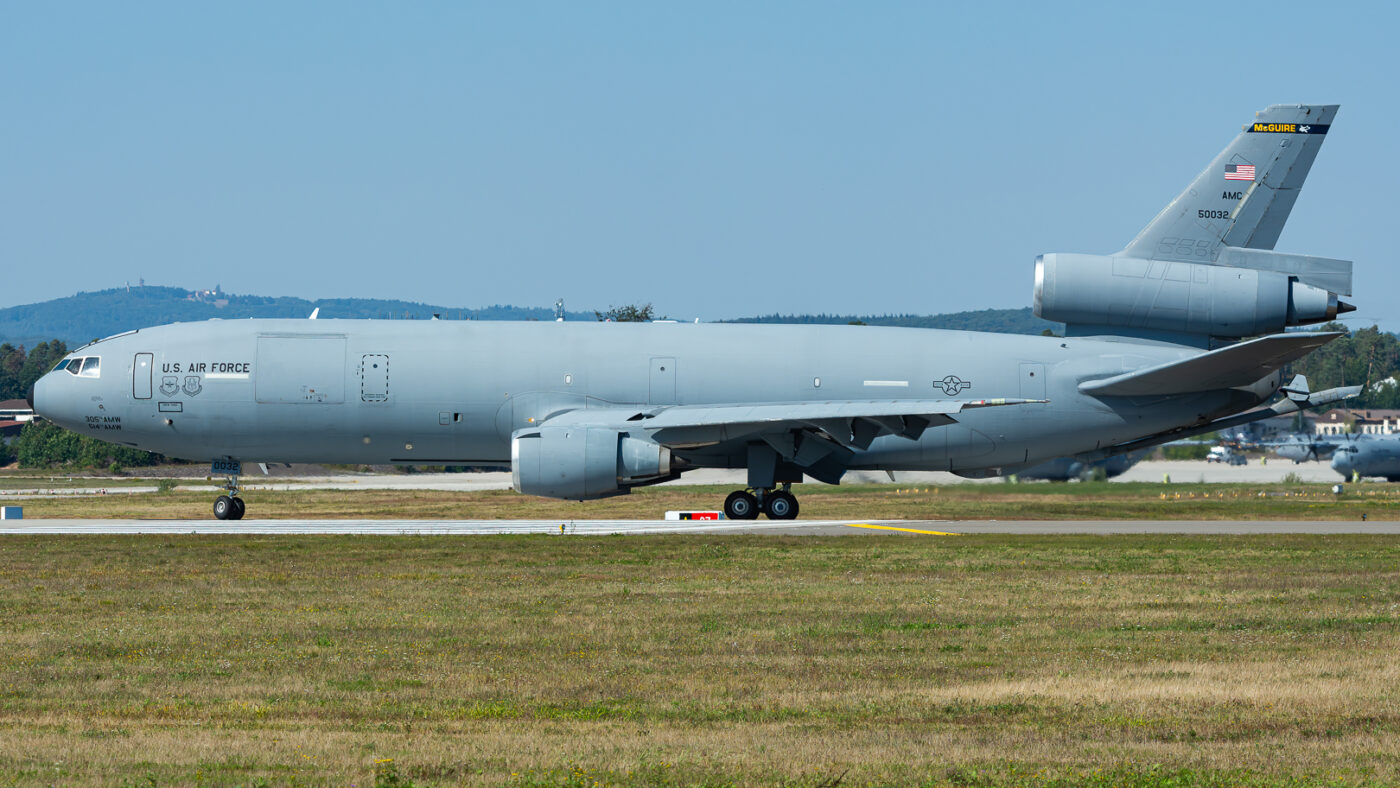
A former United States Air Force KC-10A Extender departed Davis-Monthan Air Force Base (DMA) on 20 October, heading for San Antonio International Airport (SAT), where the aircraft is understood to be undergoing maintenance and preparation for its return to service.
The tanker had reportedly remained grounded for approximately five years before making the flight.
The aircraft is the first of 10 KC-10As acquired by Omega Aerial Refueling Services through a US government auction held in the spring of 2025. Its acquisition represents a considerable addition to the company’s existing tanker fleet, which comprises three KDC-10s and brings its total number of KC-10-family aircraft to 13.
The acquisition also gives a second life to an aircraft type that has been steadily disappearing from military service. The KC-10A, developed from the McDonnell Douglas DC-10, entered service with the USAF in 1981, having first flown in prototype form in 1980. Its retirement in 2024 marked the end of the type’s military career with the US Air Force, which had been its final military operator.
The DC-10 family has experienced a similar decline. Its successor, the MD-11, is now operated by only a handful of airlines, with just two remaining operators of the passenger and freighter variant. Against this backdrop, Omega’s acquisition provides an opportunity to preserve and extend the operational life of an aircraft that has become increasingly uncommon.
The USAF’s decision to retire the KC-10 fleet was driven by its transition towards a newer generation of aerial refuelling aircraft. Boeing’s KC-46A Pegasus, derived from the commercial 767 platform, was selected as its replacement. The transition has left a substantial number of retired KC-10s in storage at Davis-Monthan, several of which are now finding potential buyers outside the military.
Omega has established itself as a significant player in the contracted aerial refuelling market, providing services to the US military since 2000. Its operations initially centred on supporting the US Navy and Marine Corps, whose aircraft predominantly use the probe-and-drogue refuelling system. Consequently, much of Omega’s earlier fleet, including its Boeing 707s and original KDC-10, was configured around this method.
The requirements of the US Air Force presented a different challenge. Unlike naval aviation, the USAF primarily relies on the flying boom system, requiring Omega to expand its capabilities beyond probe-and-drogue operations.
A significant change came in 2021, when the company introduced two additional KDC-10s acquired from the Royal Netherlands Air Force (RNLAF). These aircraft brought flying boom capabilities into Omega’s operations, allowing it to support a wider range of US military aircraft and expand its position within the aerial refuelling contractor market.
The expansion has since allowed Omega to undertake refuelling work for aircraft including the B-52 Stratofortress and MC-130J Commando II. Contracted tanker services also provide the US military with additional flexibility, reducing the requirement to allocate its own aircraft to certain training and support missions while preserving military-operated tankers for operational requirements.
The decision to acquire 10 former USAF KC-10As is largely rooted in economics, fleet commonality and aircraft availability. Davis-Monthan offers a considerable pool of retired examples following the type’s withdrawal from military service, creating an opportunity for Omega to expand its fleet without the expense associated with acquiring newly manufactured aircraft.
There are also advantages in terms of existing operational experience. Omega already operates the KDC-10, while its wider DC-10 expertise and established maintenance infrastructure provide a foundation for supporting the additional aircraft. As one of the largest remaining operators of the DC-10 family, the company is better positioned than most to maintain and operate airframes that would otherwise become increasingly difficult to support.
The KC-10 acquisition also comes at a time when the USAF has little apparent interest in returning its retired aircraft to service. Unlike the KC-135 fleet, which continues to play a central role in American aerial refuelling operations, the KC-10s have been withdrawn from the inventory, with several airframes being made available for disposal. Four additional examples have reportedly been sold to an unidentified North African country, although the buyer has not been publicly confirmed.