
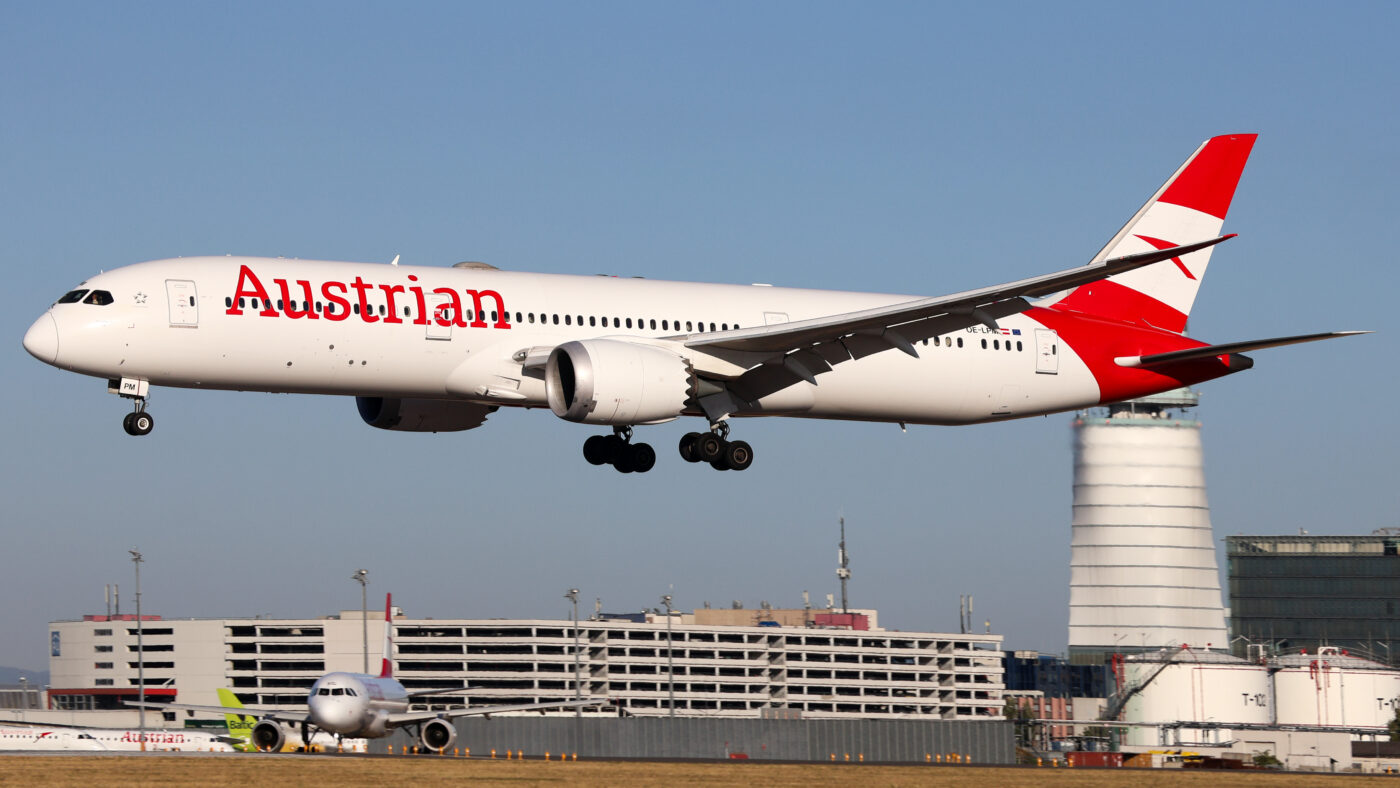
It was intended to be the largest fleet investment in Austrian Airlines’ history: twelve Boeing 787-9s were set to replace the aging Boeing 767 and 777 fleets by the end of 2028. But Lufthansa Group has altered its plans and retracted its commitment. As AUA confirmed to aeroTELEGRAPH, the five brand-new Dreamliners originally scheduled for delivery starting in late 2027 will be redistributed within the group.
This removes a major pillar of the recently announced fleet modernization for now. Austrian Airlines currently operates four Boeing 787-9s. The long-haul fleet renewal began in 2024 with two seven-year-old aircraft (OE-LPM and OE-LPL) previously flown by Vietnam’s Bamboo Airways.
The Five 787s Planned for 2027 Will Not Arrive
During 2026, two additional Dreamliners joined from Lufthansa’s fleet: OE-LPG and OE-LPI (both originally from Hainan Airlines). OE-LPI (formerly registered as D-ABPA) was delivered to Vienna in September and is currently undergoing maintenance in Taiwan before entering regular scheduled service in mid-December. Three more Boeing 787-9s from Lufthansa’s existing fleet are expected to join Austrian in 2027, bringing its Dreamliner fleet to seven.
Originally, five brand-new Boeing 787-9s direct from the factory were scheduled to arrive starting in late 2027. They would have been the first factory-new long-haul aircraft delivered to Austrian Airlines in three decades and were intended to replace the last Boeing 777s. That plan is now void.
Boeing 777s Retained Until at Least Late 2029
The Lufthansa Group decision has immediate operational consequences. Austrian Airlines confirmed:
“This means that the Boeing 777s in the fleet will continue to be operated until at least late 2029 / early 2030.”
However, an alternative solution for replacing the older long-haul jets has not been completely ruled out. An airline spokesperson noted:
“Another option could materialize for Austrian Airlines that would allow the existing Boeing 777 fleet to be replaced.”
The airline did not disclose what this alternative option might be.
Low Margins and High Hub Costs
Behind the unexpected decision by corporate headquarters in Frankfurt are the economic realities facing Austrian Airlines. The Austrian subsidiary currently generates an operating margin of just 3.2%, well below the European industry average of 6.8%. AUA CEO Annette Mann recently pointed out that this represents an operating profit of only about €5 per ticket sold.
Additionally, high location costs at Vienna Airport and the national ticket tax heavily burden performance. The aviation industry has long demanded the abolition of the tax, an effort now supported by several regional Austrian politicians. Mann highlighted the severity of the situation in an interview with business magazine Trend:
“Vienna is the second most expensive location in Europe, and that must change. We cannot survive here long-term under these conditions. We are at a crossroads: AUA functions very well operationally and customer satisfaction is high, yet we aren’t earning money.”
Tight Aircraft Market Dynamics
Sluggish progress in negotiations over long-term hub security in Austria also influenced the group decision. Austrian Airlines emphasized:
“The current talks on hub security with Austrian politicians are a crucial building block to move the necessary renewal of Austrian’s long-haul fleet forward.”
The airline explicitly links the future of its long-haul fleet to the business environment in Vienna. At the same time, Austrian Airlines cited tight supply across the global aircraft manufacturing market, where both Boeing and Airbus are lagging years behind delivery schedules.
What Lies Ahead?
This shortage escalates competition within Lufthansa Group for available aircraft deliveries.
“Consequently, new aircraft deliveries are heavily contested within Lufthansa Group. Replacement and growth capital is allocated where it offers the best long-term economic outlook.”
Austrian Airlines stated. For the Austrian carrier, this means surrendering five new Dreamliners for now and extending the lifespan of its Boeing 777 fleet.
The project once heralded as the largest fleet investment in company history is off the table in its original form. How fast Austrian Airlines can advance its long-haul fleet renewal now hinges largely on whether economic conditions at its Vienna hub improve.