
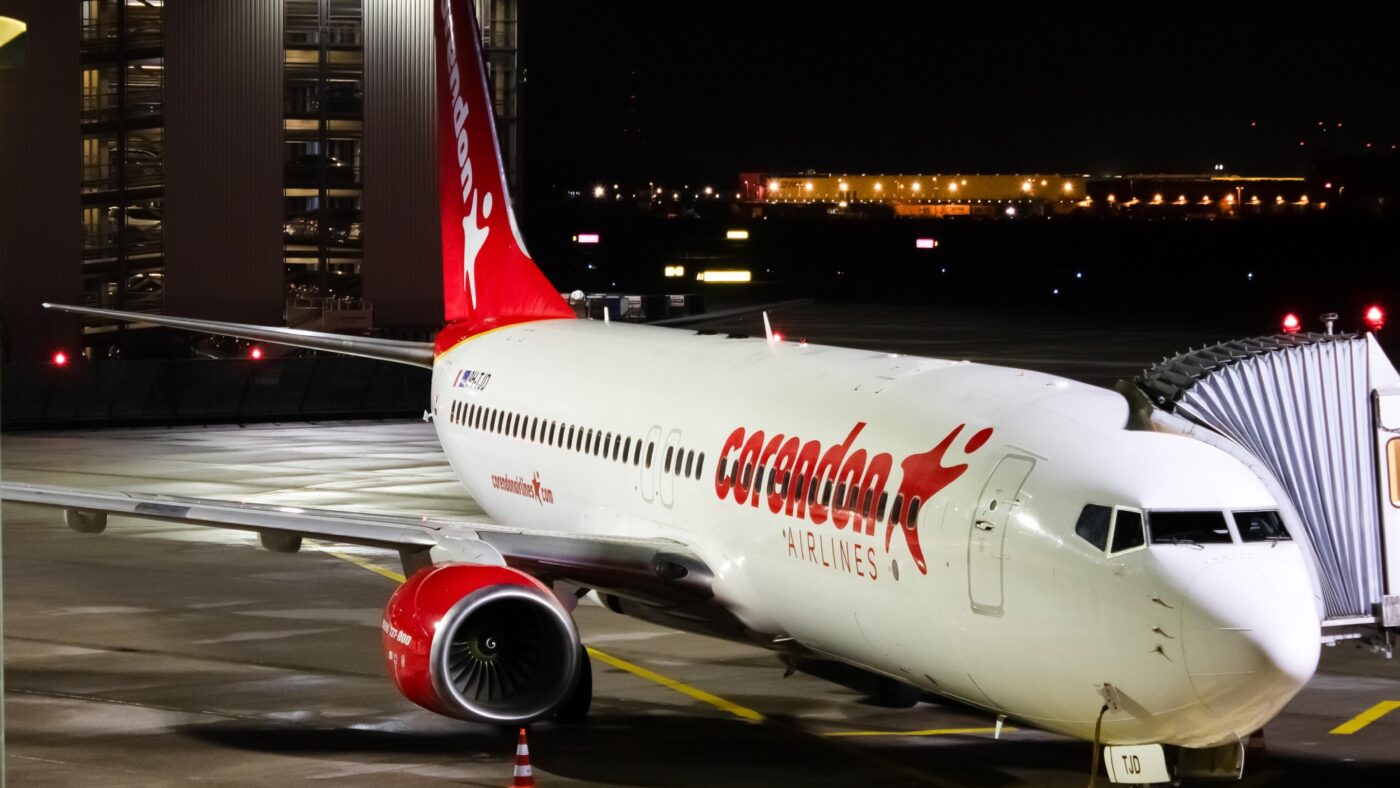
A suspected security incident aboard a passenger aircraft temporarily brought flight operations at Nuremberg Airport to a standstill on Tuesday afternoon.
Corendon Airlines Europe flight XR456 from Corfu transmitted the transponder code 7500, which is the international code for unlawful interference, such as a hijacking. Because the crew was temporarily unreachable by radio, two Eurofighters from the German Air Force took off and escorted the Boeing 737-800 to Nuremberg. Corendon has since cited a technical malfunction in the radio communication system as the cause of the alert. The aircraft landed safely, and no danger to the passengers was identified.
Transponder Signal Triggers Military Response
The aircraft involved was a Boeing 737-800 with the registration number 9H-CXD, which was en-route from the Greek island of Corfu to Nuremberg on Tuesday. During the flight, code 7500 was transmitted. Since this code indicates a possible hijacking or other form of unlawful interference, and radio contact with the crew could not be reestablished at times, the relevant authorities initially had to assume a potentially serious security situation.
Two Eurofighters from Tactical Air Force Squadron 74 in Neuburg an der Donau were subsequently alerted. The fighter jets escorted the passenger aircraft through German airspace until it landed. Such an operation serves to identify and monitor an aircraft when the security situation is unclear, and to assess the situation from the air. It does not in itself mean that a suspicion of hijacking has been confirmed.
Airport Temporarily Suspends Operations
In parallel with the measures taken in the air, security forces in Nuremberg prepared for the aircraft’s arrival. The police cordoned off the airport area and temporarily suspended flight operations. This was done to ensure that the landing and subsequent inspections could take place under controlled conditions.
The Boeing 737-800 landed safely in Nuremberg at 12:16 p.m. Emergency responders then assessed the situation on the ground. After initial procedures were completed, the passengers were able to exit the aircraft and were transported to the terminal by bus. Around 1:20 p.m., the police gave the all-clear after the inspections revealed no danger. Flight operations resumed shortly thereafter.
The disruption also affected other flights. According to the Associated Press, there were six delayed flights and two diversions. The incident was therefore not limited to the affected aircraft but also temporarily disrupted the airport’s other operations.
Corendon Attributes the Alarm to a Radio Interference
Over the course of the afternoon, Corendon Airlines provided further details on the possible cause. According to the airline, there was a brief disruption in the radio communication system over Croatian airspace. As a result, the code 7500 was transmitted in error. Corendon stated that there was never an actual emergency situation and that neither the passengers nor the crew were in any danger.
The statement thus provides a plausible explanation for the alarm, but should be distinguished from an independently confirmed technical investigation. Initial reports from the police had initially cited a possible malfunction of the cockpit radio as the cause. As of the time of this article, no final investigation report was available to confirm the technical sequence of events in detail.
Security procedures are triggered even in the event of false alarms
The incident demonstrates how closely civil air traffic control, the Air Force, the police, and airport operations work together in the event of a potential security threat. Transponder code 7500 is an internationally standardized signal that requires a specific response. If radio communication fails at the same time, those in charge cannot readily distinguish between a technical malfunction and an actual threat.
For this reason, the established procedures must be consistently applied first. Only once additional information is available and the situation has been verified can the alarm be reliably assessed. The fact that the suspicion in Nuremberg was not confirmed does not change the fact that emergency responders had to act based on the information initially available.
The incident ended without any identified danger to the people on board. Corendon’s statement points to a technical malfunction as the cause. It remains to be seen whether further investigations will reveal additional details about the malfunction and the transmission of the transponder code.