
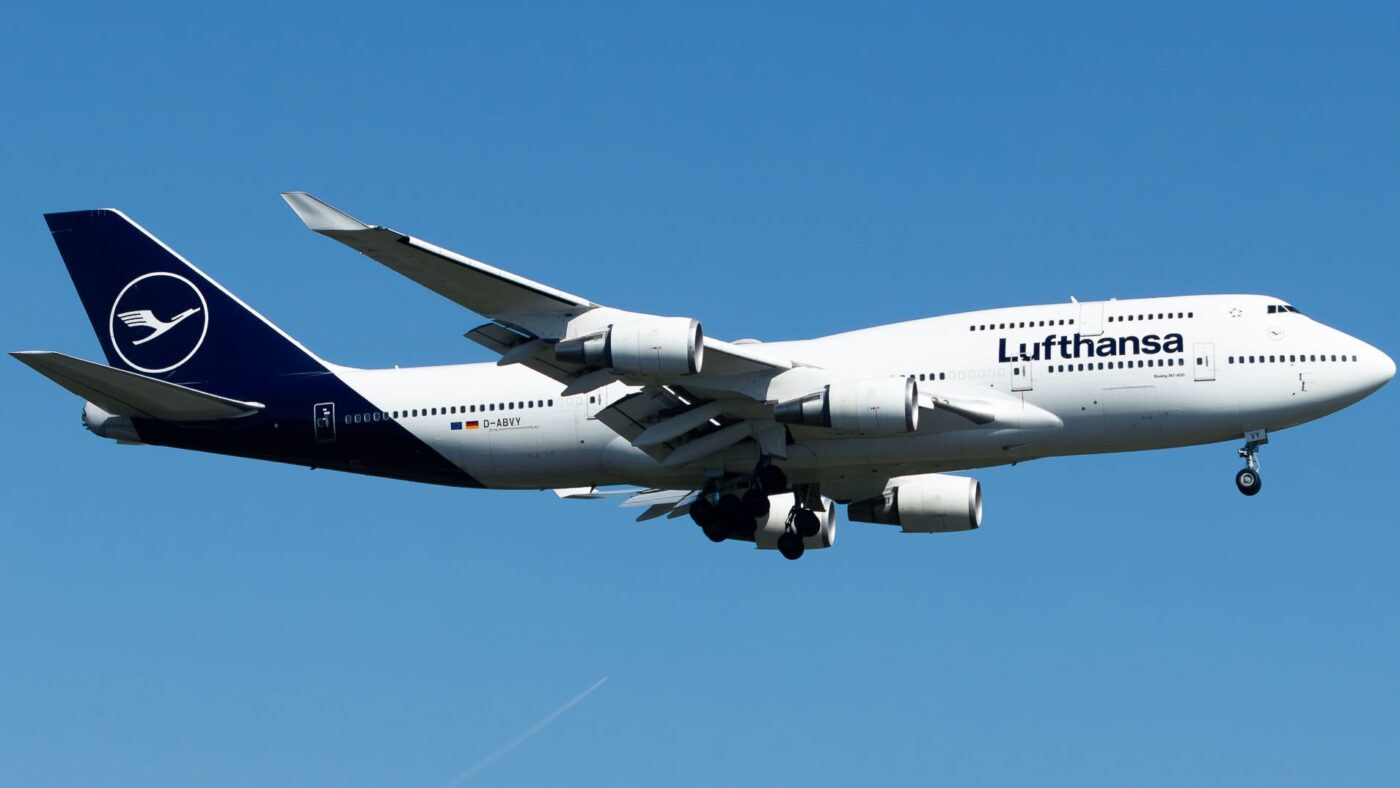
Manchester, England, 26 September 2026 — A Lufthansa Boeing 747-400 operating flight LH470 from Frankfurt to Toronto was diverted to Manchester Airport after the crew detected an unusual smell in the cabin. The aircraft, registered D-ABVY, was carrying 371 passengers when the diversion occurred.
According to Lufthansa spokesperson Anne Hahn, the aircraft “turned back over Scotland for safety reasons.” The airline confirmed that the reason for the diversion was a smell in the cabin. The crew declared an emergency in order to receive priority for landing, and the aircraft landed safely in Manchester at around 15:57 local time.
The Diversion to Manchester
Flight LH470 had departed Frankfurt for its scheduled service to Toronto. While the aircraft was over Scotland, the crew decided that continuing across the Atlantic was not appropriate. The Boeing 747-400 was therefore redirected towards Manchester, one of the largest airports in the United Kingdom and an airport capable of handling a wide range of long-haul aircraft.
The aircraft landed safely and was met by emergency services. Lufthansa explained that the Boeing 747 had landed with more fuel than it would normally have had on arrival because it had been diverted relatively early in its journey. As a precaution, the aircraft was inspected by the airport fire department after landing. Lufthansa said that the passengers were subsequently able to leave the aircraft normally.
Importantly, Lufthansa has not publicly identified a specific technical fault as the cause of the smell. Reports from passengers mentioned additional details about the situation inside the cabin, but these have not been confirmed by Lufthansa. The airline stated that the Boeing 747-400 was being inspected in Manchester.
Lufthansa also confirmed that all 371 passengers were accommodated in hotels overnight. The airline apologized for the disruption and emphasized that safety is its priority.
“The safety of our passengers and crew is our top priority at all times.”
A Second Boeing 747 Arrives
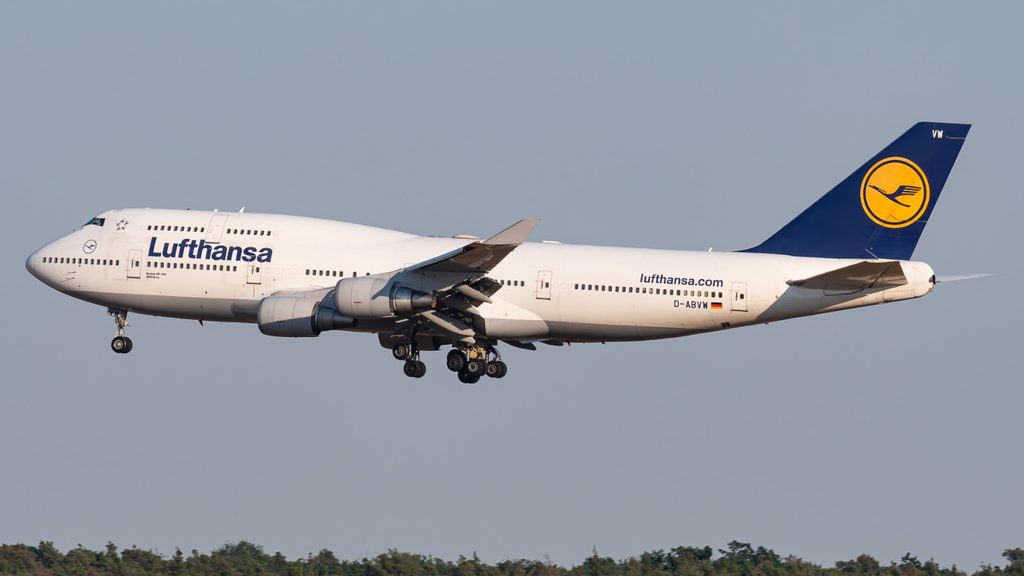
Following the diversion Lufthansa sent another Boeing 747-400 to Manchester to continue the passengers’ journey to Canada the next day.
The replacement aircraft was registered as D-ABVW. It operated a replacement service from Manchester to Toronto on September 27, allowing the passengers from the diverted flight to continue their journey without having to wait for the original aircraft to complete its inspection. Lufthansa confirmed that the replacement flight departed Manchester at 16:40 UTC and arrived in Toronto at 23:52 UTC.
The decision to use another Boeing 747 is notable because the type is becoming increasingly rare in passenger service. It also resulted in an unusual situation at Manchester: the airport temporarily had two Lufthansa Boeing 747-400s on the ground, with one undergoing inspection and the other being prepared for the flight to Canada.
The Boeing 747-400
The Boeing 747-400 is one of the most recognizable aircraft in commercial aviation. Lufthansa describes the aircraft as a “Jumbo,” a name that reflects its size and its importance in the development of long-hall flights. The 747-400 is almost 71 meters long and has a wingspan of more than 64 meters.
Lufthansa’s 747-400 has a maximum cruising speed of around 920 km/h and can fly at an altitude of up to 13,700 meters. The aircraft has four General Electric CF6-80C2 engines and a range of around 12,200 kilometers, according to Lufthansa’s technical data. Its standard configuration provides 371 seats, including 67 in business class, 32 in premium economy, and 272 in economy class.
Despite the aircraft’s age, the 747-400 remains an important part of Lufthansa’s long-haul fleet. However, its future is limited. In its 2025 annual report, Lufthansa Group stated that the 747-400 is planned for complete retirement as the group continues to replace older four-engine aircraft with newer and more efficient types.
A Rare Appearance in Manchester
The diversion of LH470 was therefore more than just an unusual operational event. It brought one of Lufthansa’s iconic Boeing 747-400s to Manchester unexpectedly and resulted in a second aircraft of the same type arriving the following day.
For the passengers, the priority was reaching Toronto safely after an unexpected interruption to their journey. For aviation enthusiasts, however, the event provided a rare opportunity to see two Lufthansa 747-400s at Manchester within a short period of time.
Lufthansa has confirmed that the original aircraft remained in Manchester for inspection. The airline has not stated publicly what caused the smell or when D-ABVY will return to normal operations. What is clear is that the crew’s decision to divert allowed the situation to be investigated on the ground while the passengers were provided with an alternative way to continue their journey.