

A VistaJet Cessna Citation XLS+ landed at RAF Fairford by mistake on 12 September 2026 while travelling from London City to Cotswold Airport at Kemble.
The German-registered aircraft, D-CJMK, prompted a security response at the US-operated military airfield before continuing to its intended destination later that day. Fairford lies approximately 11 miles east of Kemble, leaving the business jet just a few minutes’ flying time from the airport it was meant to reach.
London City flight ends at RAF Fairford
The operator of the aircraft is VistaJet Germany and Flightradar24 records its departure from London City at 08:49 BST on Saturday morning.
The Citation arrived at Fairford shortly after 09:00 local time. The pilot recognised the mistake and wanted to depart immediately, but base security required the aircraft to remain while interviews and paperwork were completed. It stayed for approximately three hours.
Fairford supports US Air Force bomber deployments and other military flying operations. Its published military aeronautical information requires advance coordination for civilian arrivals, giving an unexpected business jet arrival a different significance from a routine landing at a commercial airport.
Flightradar24 analysis: the approach to Fairford and onward flight
Flightradar24 imagery shows D-CJMK approaching the Fairford area from the southeast, passing near Swindon before tracking northwest. The aircraft then follows a broad curve around the north and east of the military airfield before turning west toward its runway. This final alignment is consistent with an approach to Fairford’s Runway 27.
Cotswold Airport at Kemble is visible farther west, clearly separate from the airfield around which the Citation manoeuvred. The flight history lists H5373’s intended destination as Kemble, with the arrival recorded as “Diverted to FFD”.
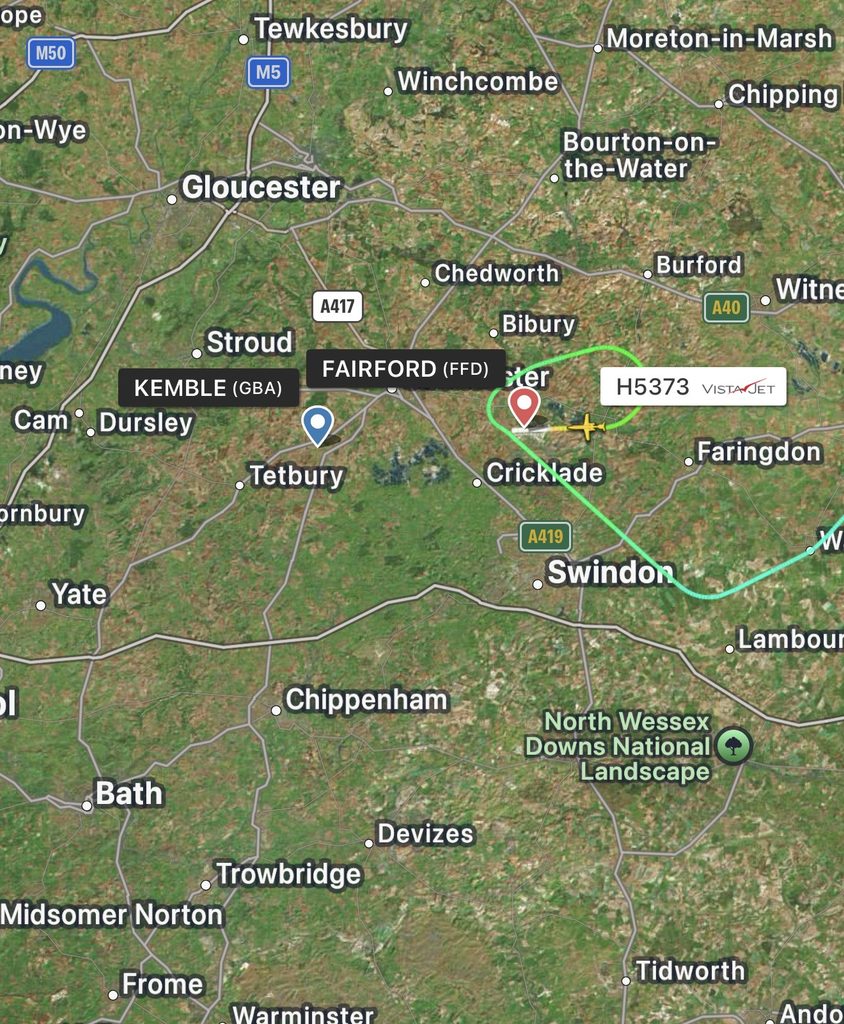
The second image shows the subsequent repositioning flight, following a nearly direct westbound route from Fairford to Kemble. Flightradar24’s flight history records departure at 12:16 BST and arrival at 12:22 BST, making the final leg just six minutes long after approximately three hours on the ground at Fairford.
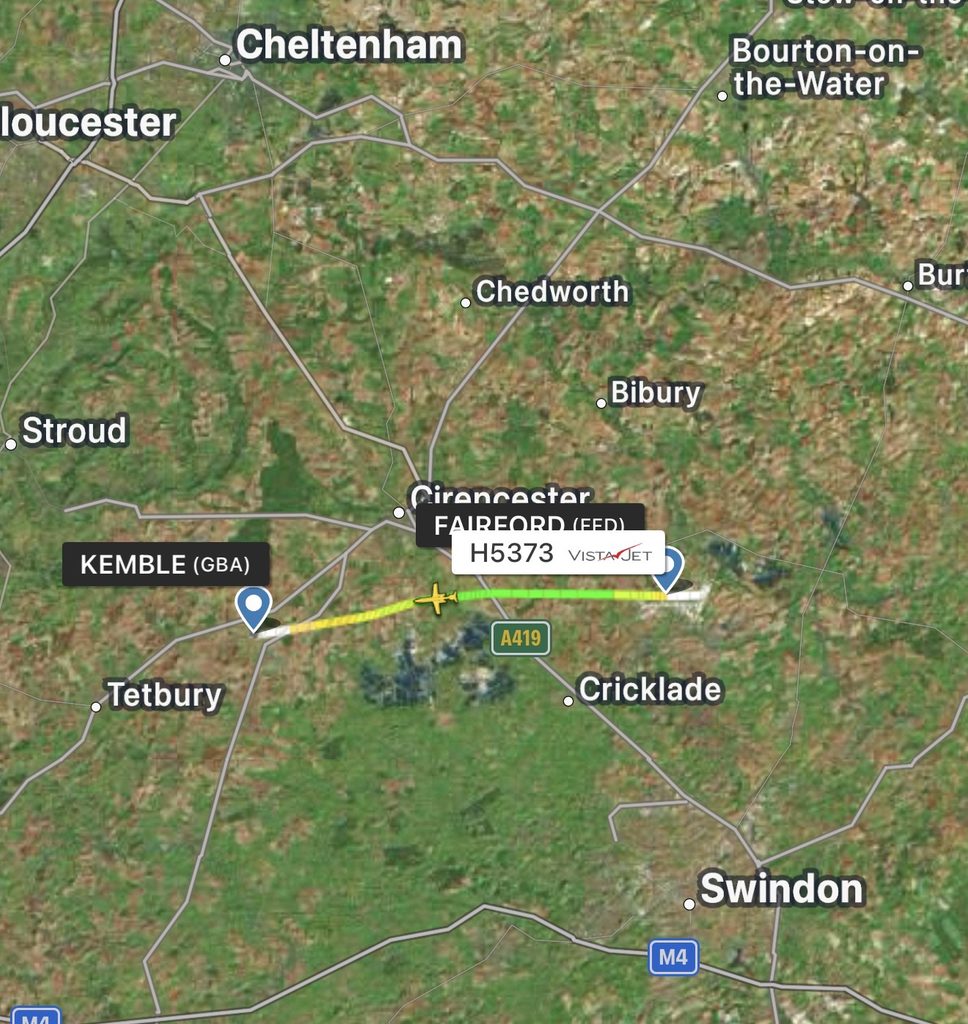
Together, the images illustrate the approach flown and how close the two airports are. They do not establish what the crew believed or which communications preceded the mistaken landing.
Two nearby airfields with similar runway directions
Kemble and Fairford lie at almost the same latitude, with their main runways running broadly east to west. Cotswold Airport’s paved runway is designated 08/26, while Fairford uses 09/27.
Their proximity and broadly similar orientation provide context for the incident, although they do not establish its cause. A runway appearing in roughly the expected direction can reinforce an incorrect assumption about an aircraft’s position. The runway number, surrounding features and navigation information provide separate checks on that assumption.
The two airfields also serve very different purposes. Cotswold Airport accommodates business aviation, general aviation and aviation-related commercial activity. Fairford’s military role includes supporting deployed bomber forces, with access and operating arrangements tailored to those missions.
What Kemble’s flight information service provides
Cotswold Airport provides an Aerodrome Flight Information Service, using the radio callsign “Kemble Information”. Its staff supply information to help pilots conduct their flights, including relevant traffic, weather and aerodrome conditions.
This differs from an air traffic control service. Flight information officers generally do not issue instructions to airborne aircraft, and pilots remain responsible for their decisions and the safe conduct of the approach.
Flight information officers can also issue safety advice and warnings. How the service interacted with this flight has not been established, and its status alone does not explain the mistake.
Kemble also has published RNP instrument approaches to its paved runway. The airport’s use of a flight information service therefore does not mean that arriving crews have no instrument approach procedure available.
The same airport mix-up occurred in 2016
A previous incident provides a documented example of how a pilot can mistake Fairford for Kemble.
On 23 April 2016, a Piper PA-30 Twin Comanche, registered G-ATXD, landed at Fairford while intending to visit Kemble. The Air Accidents Investigation Branch recorded that the pilot knew Kemble well but had approached the area by a different route from his usual one.
After changing radio frequency earlier than normal, he saw Fairford’s runway in a position that matched his expectation of where Kemble should be. He became convinced that he had identified the correct airfield and did not check his position. The report also recorded distraction from explaining the landing procedures to his passengers.
The pilot described the event as “a classic case of confirmation bias”. He recognised the error on touchdown and informed Kemble.
The earlier pilot’s account documents a known risk at these neighbouring airfields. Whether similar circumstances contributed to D-CJMK’s landing remains unclear.